Comment Publised in Nature Electronics!
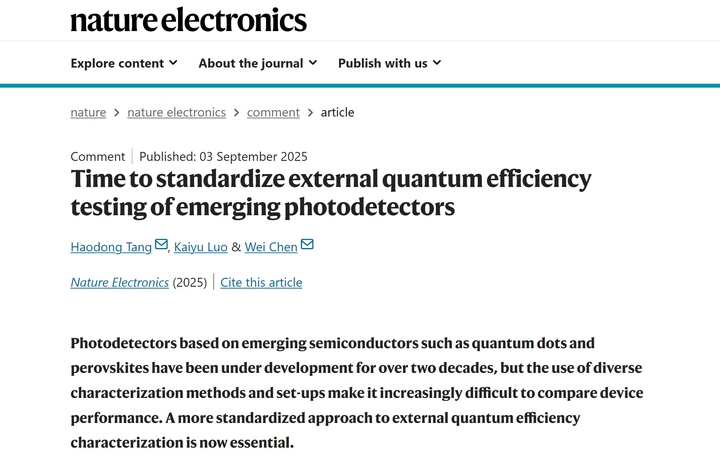
🎉 Nature Electronics | Toward Standardization of EQE Testing for Emerging Photodetectors
We are excited to share that the research team led by Haodong Tang and Wei Chen at Shenzhen Technology University has published a Comment article in Nature Electronics, entitled: 📝 “Time to standardize external quantum efficiency testing of emerging photodetectors” 🔗 DOI: 10.1038/s41928-025-01446-7
🔍 Background
Emerging photodetectors based on quantum dots, perovskites, and other novel semiconductors are rapidly advancing. Yet, differences in: 💡 Light sources, ⚖️ Power & photon flux calibration, 📐 Illumination geometry, and 📊 Readout conditions (bias, bandwidth, filtering) have made EQE testing inconsistent across labs, limiting comparability and reproducibility.
🚀 Key Contributions
This article does not aim to report “higher EQE values,” but instead proposes a standardized testing framework to ensure transparent, reproducible, and comparable results:
✅ Linear response validation – Confirm the device operates in a linear power–response regime before EQE is measured. 🔄 Methodological clarity – Clearly distinguish between the direct method (calibrated photon flux + photocurrent) and the indirect method (responsivity-based), and state their assumptions. 📑 Uncertainty reporting – Provide uncertainty budgets and encourage cross-validation between teams.
Figures in the article illustrate:
📈 Linear vs. nonlinear response regimes (showing when EQE is valid). 🔦 Direct vs. indirect methods and how results vary depending on light sources and calibration.
🌐 Significance
The message is clear: ✨ Progress in EQE research lies not in bigger numbers, but in establishing a unified, physics-grounded measurement protocol.
By defining minimum reporting standards and improving method transparency, this work lays the foundation for reliable, comparable, and reproducible evaluation of next-generation photodetectors.
👉 Congratulations to the team for this impactful contribution that strengthens the foundations of emerging optoelectronics! 🎉
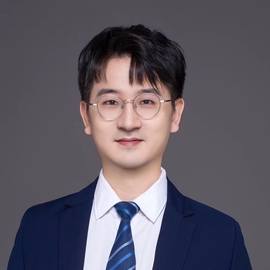
Haodong TANG
Assistant Professor
My research interests include optoelectronic devices, colloidal quantum dots and CMOS image sensors.